
Around Dudmore, even the rabbits have history.
For centuries, Aldbourne supported one of Wiltshire’s remarkable coney warrens so extensive that one of its three seventeenth-century divisions was known as Dudmore Walk. Its rabbits supplied great households, the royal table and a growing commercial market; at its height, the warren could hold as many as 24,000 animals.
And beneath that story lies something older still. Just 850 metres from Dudmore Lodge, a protected prehistoric bowl barrow stands on a chalk spur overlooking the Chase, while Mesolithic finds show people using the Aldbourne landscape some 8,000 years ago.
At Dudmore, history does not simply stretch back. It burrows down.
The rabbit that became a luxury
Burrow down far enough at Dudmore and history becomes prehistory. But first, there are the rabbits.
Today they are such a familiar part of the English countryside that it is easy to assume they have always been here. They have not.
Rabbit remains show that individual animals were present in Roman Britain, but the managed populations that established the rabbit as a lasting part of the British landscape belong principally to the centuries after the Norman Conquest. Historic England places the development of managed warrens in southern England from around the beginning of the twelfth century, while modern mammal research likewise distinguishes Roman-period introductions from the much more important medieval establishment of the species.
Nor were medieval rabbits the commonplace country creatures we think of today.
They were coneys — the term generally used for adult rabbits — and for much of the Middle Ages they were deliberately bred and protected. Their meat was desirable and their skins valuable. Creating a successful warren required land, management and protection, so the earliest English warrens were closely associated with wealthy landowners, castles, monasteries and high-status households. Historic England describes medieval rabbits as rare and highly prized and notes that early warrens were principally an elite privilege.
Wiltshire was particularly well suited to the business.
Rabbits prospered on its light, freely draining chalk soils and steep downland — ground that could be relatively poor for crops but highly productive when managed as a warren. Historian Joseph Bettey’s study of the Wiltshire rabbit industry shows how these otherwise marginal slopes could become lucrative commercial landscapes producing thousands of animals.
Aldbourne became one of the outstanding examples.
Aldbourne’s famous coneys
By the later Middle Ages, Aldbourne’s rabbits were travelling far beyond the downs on which they had been raised.
In 1372, the Aldbourne warrener was instructed to send six dozen rabbits to the Savoy in London and fifteen dozen to Hertford Castle for Christmas. Six years later, the Abbess of Lacock was entitled to receive four dozen from the warren as compensation for damage caused to adjoining land. These records reveal two sides of the rabbit economy at once: coneys were sufficiently desirable to travel to prestigious households, but sufficiently numerous to create very real problems for neighbouring landowners.
By the early fifteenth century, the business had become enormously valuable.
Between roughly 1390 and 1430, rabbit sales from Aldbourne produced about £40 annually, sometimes representing approximately half the profit generated by the demesne of Aldbourne manor. That is an extraordinary economic contribution from one species.
In 1434, Aldbourne could supply almost 1,000 rabbits, valued at £14, to the royal household, while another sixty-six couples were sold to other customers. Records also show Aldbourne rabbits entering commercial distribution beyond the great households, including sales to London dealers. The warren was therefore not simply supplying aristocratic dining rooms: it was already participating in a wider food economy.
That tells us something important about who ate Aldbourne’s rabbits.
At first, rabbit in England carried considerable status. It appeared in the world of kings, princes, aristocratic households and wealthy religious institutions. Aldbourne’s documented destinations place its coneys directly within that elite economy. But over the following centuries the consumer base widened. Population growth and expanding towns increased demand for relatively affordable fresh meat, while rabbit skins and fur had a separate commercial life in clothing and, particularly in the early-modern period, the manufacture of hats and caps.
In other words, the rabbit travelled socially as well as geographically.
It began medieval life in England as a protected and comparatively prestigious commodity. With greater production it reached merchants, urban consumers and progressively broader sections of society. By the later eighteenth century, the social meaning had almost reversed: Historic England notes that rabbit had become associated with poorer food rather than elite dining.
Aldbourne witnessed that entire transformation on an unusually large scale.
And its reputation was not a modern invention.
The seventeenth-century Wiltshire antiquary John Aubrey singled Aldbourne out in his Natural History of Wiltshire. He regarded its coney warren as famous and considered the local rabbits exceptionally sweet, fat and compact compared with rabbits elsewhere in England. Whatever allowance we make for Aubrey’s enthusiasm, his testimony demonstrates that Aldbourne’s coneys possessed a recognised reputation by the seventeenth century.
Long before anyone thought of marketing the Wiltshire countryside to visitors, Aldbourne already had a rabbit with a reputation.
Dudmore Walk
For Dudmore, however, the most important discovery is more precise.
By the seventeenth century, the enormous Aldbourne warren was organised into three principal divisions, known as walks.
There was North Walk to the north of Aldbourne, Southwood Walk to the south — and Dudmore Walk, lying west of the village.
So Dudmore was not merely a house that happened to stand somewhere near an area famous for rabbits.
Its name was embedded in the geography of the warren itself.
A “walk” in this context was a managed territorial division of the warren, part of the practical organisation of a landscape devoted to producing and controlling very large rabbit populations. The surviving record therefore places Dudmore directly inside the administrative geography of the industry.
The business required considerably more husbandry than the word “wild rabbit” might suggest.
Across Wiltshire’s commercial warrens, rabbits were actively managed. Artificial burrows were created where necessary, winter fodder was supplied, predators controlled and boundaries maintained in an attempt to keep valuable animals in and unwanted hunters out. Bettey’s research records hay, coarse grasses, bracken and branches whose bark rabbits could eat during severe winters. Historic England likewise describes purpose-built coneygarths and artificial mounds as characteristic features of medieval rabbit management.
At Aldbourne itself, early-eighteenth-century records are wonderfully specific: the rabbits grazed the thin downland grass during summer but were given hay and hazel cuttings in winter.
The warrener therefore had a serious job.
He was managing a valuable crop that happened to move.
Rabbits had to be bred in sufficient numbers without exhausting their feeding grounds, protected from foxes, stoats, weasels, hawks and human poachers, supported through winter weather and harvested without unnecessarily damaging either meat or fur. Seventeenth-century Wiltshire evidence records the use of nets, ferrets and dogs, alongside elaborate arrangements for feeding and protecting warren populations.
And at Aldbourne, the numbers became astonishing.
By the end of the seventeenth century, historical sources describe a standing stock of around 8,000 rabbits, capable of increasing during the breeding cycle to approximately 24,000. Aldbourne Heritage Centre places the same figures in the early eighteenth-century chronology and records 24,000 rabbits counted on the Warren in 1724.
To picture twenty-four thousand rabbits across the downs is to understand that “warren” did not mean a few burrows behind a hedge.
It was an agricultural industry.
From warren to farmland
Success, however, created its own problem.
A rabbit does not recognise a property boundary.
The more profitable a warren became, the greater the risk that animals would escape into neighbouring cornfields, pasture, woodland and coppices. Across seventeenth-century Wiltshire, farmers repeatedly complained about crop and woodland damage, while rising grain prices made the conversion of downland to arable farming increasingly attractive. Bettey identifies precisely this tension — profitable rabbits on one side, increasingly profitable crops and increasingly frustrated neighbours on the other — as a major reason for the eventual decline of Wiltshire’s great warrens.
Aldbourne was no exception.
Indeed, Dudmore stood directly at the centre of that transition.
In 1652, Philip Herbert, Earl of Pembroke and Montgomery, who held the right of warren, reached an agreement with the tenants of Aldbourne manor that Dudmore Walk and Southwood Walk should be diswarrened. The Earl received a separate holding of 571 acres in compensation, and parts of the former warren were soon put under the plough.
It was not a clean ending.
By 1657, the agreement had broken down. The Earl again asserted warren rights, and litigation continued until at least 1671. Other parts of the Aldbourne warren remained productive; later in the century, North Walk was still operating as a warren.
That complication is historically valuable because it shows what was really happening to the countryside.
Aldbourne was moving from one agricultural economy to another.
Land that had been highly valuable because it could sustain thousands of rabbits was becoming increasingly valuable for cultivation. The rabbit, once deliberately nurtured, was becoming an obstacle to the plough.
The transformation continued over generations. The 1809 enclosure encompassed thousands of acres of open fields and downs, including about 800 acres in North Walk, the surviving great division of the old warren. By 1837, Dudmore Lodge was recorded as a compact farm of about 637 acres, with more than half of its acreage under arable cultivation.
In that progression from Dudmore Walk to Dudmore Lodge farm one can read a much larger change in the English countryside.
The landscape was not static. It was repeatedly made and remade according to what people valued most: first hunting and protected game, then commercial warrening, then increasingly intensive agriculture.
The rabbits helped shape the land.
Then the economics of the land helped push the rabbits aside.
Beneath the warren, deeper time
And yet even the centuries of warrening represent only the uppermost layer of Dudmore’s landscape.
Less than a kilometre away, 850 metres west-north-west of Dudmore Lodge lies a protected prehistoric monument.
Historic England records a scheduled bowl barrow on the southern edge of a chalk spur overlooking Aldbourne Chase. Its surviving mound measures approximately 34 metres across and 0.7 metres high, surrounded by a now-infilled ditch about two metres wide. Historic England considers the monument sufficiently well preserved to retain evidence concerning its construction and use, while the old ground surface sealed beneath it may preserve environmental information about the landscape in which it was created.
Beneath the mound may survive traces of a countryside that existed before the barrow was raised, a buried surface from a world thousands of years older than Dudmore Lodge.
Wiltshire Council’s archaeological history of Aldbourne records human use of the parish extending back around 8,000 years. Assemblages of Mesolithic flint dating to around 6000 BC indicate temporary occupation; Neolithic artifacts have been found particularly north of the village; and the surrounding downs carry numerous prehistoric round barrows. The council records about twenty round barrows in the Aldbourne area, together with evidence of later prehistoric settlement around Upham and Woodsend.
Modern archaeological work reinforces that picture. Excavation and survey around Aldbourne have recovered Mesolithic and Neolithic flint material, Bronze Age pottery and evidence of later prehistoric and Romano-British activity.
So the chronology beneath Dudmore becomes wonderfully inverted.
The Tudor and Stuart history belongs to centuries.
The rabbit warren belongs to centuries more.
The barrows belong to millennia.
And the first known people moving through these downs take the story back towards 6000 BC.
The wider Wiltshire landscape carries the journey further still in physical form. The Ridgeway, popularly described as Britain’s oldest road, follows high ground used by travellers since prehistoric times and has a history extending at least 5,000 years. At Avebury, the great henge contains the largest stone circle in Britain, created within a ceremonial landscape developed during the Neolithic. Nearby stands Silbury Hill, some 30 metres high: the largest prehistoric artificial mound in Europe, built in stages and reaching essentially its final form by about 2300 BC.
This is the deeper pleasure of Dudmore lodge.
Look across the grass and you can imagine a warrener watching thousands of coneys on the downs.
Go back further and those same slopes belong to medieval farmers, hunters and travellers.
Further still, and the houses disappear.
The fields disappear.
The familiar boundaries disappear.
What remains is chalk, sky and people moving through a landscape already ancient long before anyone called it Dudmore.
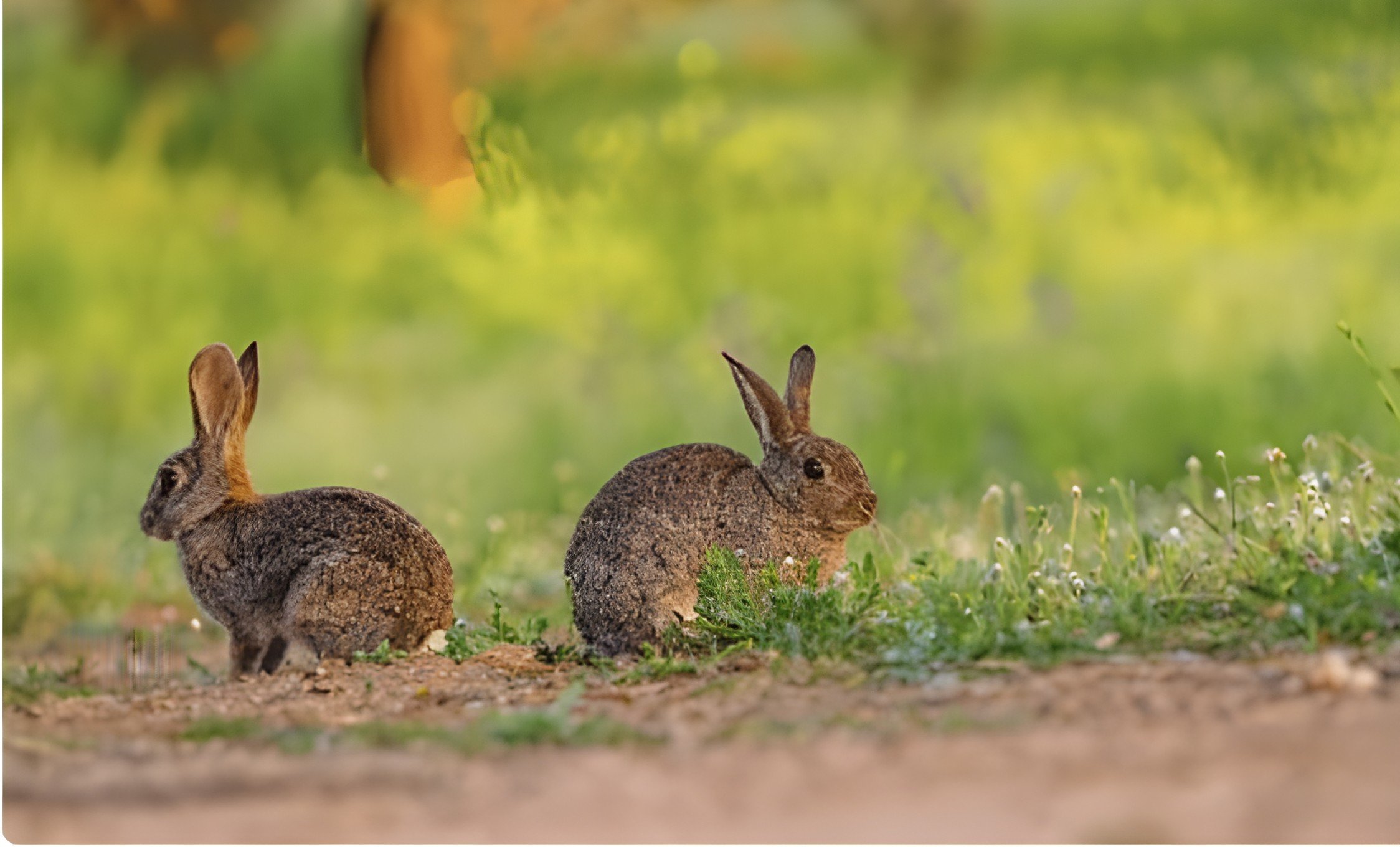
So go ahead: burrow.
From Dudmore Walk and Aldbourne’s celebrated coneys to the prehistoric mound less than a kilometre away, every layer takes you further back. And the deeper you travel into this landscape, the older and stranger its story becomes.