
A house with history. A landscape with memory.
Dudmore Lodge has stood through more than four centuries of English history. It has been enlarged, altered and reimagined by successive generations, while the landscape beyond its walls has witnessed disputes, soldiers, social change and the transformation of rural England itself.
What makes Dudmore particularly compelling is that some of this history did not simply happen somewhere nearby. On more than one occasion, it came remarkably close to the front door.
A Tudor house already making history
The origins of Dudmore reach back considerably further than the appearance of the house today might suggest.
Historic England describes the present Grade II-listed building as principally early nineteenth century, but importantly records that it incorporates fragments of a late-sixteenth-century building. It also identifies the site with an earlier hunting lodge, enlarged by the Walrond family around 1580.
There is documentary evidence placing Dudmore firmly in the Tudor period even before that enlargement.
On 28 November 1560, during the reign of Elizabeth I, an official examination of witnesses was conducted at Dudmore Lodge itself.
The proceedings concerned a long-running dispute over rights and activities in the surrounding countryside. More than four and a half centuries later, the surviving record is remarkable for something very simple: it names Dudmore Lodge as the place where evidence was heard.
We can therefore picture Dudmore not merely as a building appearing retrospectively in later histories, but as a functioning house in November 1560, important enough to serve as the setting for an official inquiry.
Among those questioned was Robert Hall of Aldbourne, then said to be about eighty years old, whose recollections stretched back some fifty years. Through the testimony taken at Dudmore that day, the surviving documentary story of the Lodge reaches indirectly towards the opening decades of the sixteenth century.
The building continued to evolve. Around 1580 the Walrond family enlarged the lodge, and fragments of that late-Tudor structure remain incorporated within the house that stands today.
But within little more than sixty years, the countryside around Dudmore would witness events of an altogether different character.
When war came to Dudmore
In September 1643, England was in the grip of Civil War.
The Earl of Essex's Parliamentarian army had relieved the besieged city of Gloucester and was attempting the difficult journey back towards London. King Charles I's Royalist forces were pursuing it, seeking an opportunity to stop Essex before he could reach the capital.
On 18 September 1643, that pursuit reached Aldbourne.
On the open country around Aldbourne Chase, north of Dudmore Lodge, Parliamentary troops encountered Royalist cavalry commanded by Prince Rupert of the Rhine, nephew of Charles I and one of the most celebrated — and feared — cavalry commanders of the Civil War.
The resulting engagement is generally known as the Skirmish of Aldbourne Chase.
Royalist cavalry attacked the Parliamentarian column and drove elements of Essex's force back towards Aldbourne. Contemporary and later local accounts place the fighting across the country north of Dudmore, making the Lodge's immediate landscape part of the military action.
The Parliamentarians were forced back towards the village. During the confusion, ammunition wagons were destroyed before Essex's forces continued eastwards towards Hungerford.
The significance of the encounter becomes clearer when viewed against what happened next.
Only two days later, on 20 September 1643, Essex's army met the King's forces again at the First Battle of Newbury, one of the major engagements of the First English Civil War.
The fighting around Aldbourne was therefore not an isolated local disturbance. It formed part of the extraordinary military pursuit preceding Newbury, as the Royalists attempted to prevent Parliament's principal field army from returning safely towards London.
For a brief moment, Dudmore stood beside the route of a campaign of national importance.
The quiet downs surrounding the house — countryside now associated with long walks, fields and distant views — would have presented an entirely different spectacle: cavalry, soldiers, horses, wagons, weapons and men retreating towards Aldbourne.
And the military presence did not disappear with the passing of Essex's army.
In the following spring, 11 April 1644, records place a vast Royalist muster on Aldbourne Chase, traditionally given as approximately 10,000 troops. Further military activity followed around Aldbourne that year.
For the people living here, the Civil War was not something being fought in distant counties. Armies moved through their landscape.
Dudmore had found itself on the edge of history.
After the soldiers
Eventually the armies moved on.
And this is perhaps the quieter but equally important part of Dudmore's story.
The seventeenth and eighteenth centuries transformed the countryside around the Lodge. Ancient patterns of land use gradually gave way to increasingly organised agricultural holdings. Fields, boundaries and farms reshaped a landscape once governed by very different customs and privileges.
Dudmore changed with it.
What had begun centuries earlier as a lodge evolved into the centre of a substantial agricultural estate.
A particularly important new chapter began in 1793, when the Church family acquired Dudmore.
Their arrival ultimately produced much of the house we recognise today.
During the early nineteenth century the older building was substantially remodelled and enlarged. Crucially, however, the past was not entirely swept away. Parts of the earlier late-sixteenth-century structure were incorporated into the new house.
That makes Dudmore less a building of one particular date than an architectural palimpsest: one generation building upon another.
The exterior still reveals those layers.
Sarsen stone and brick sit beneath slate roofs. Sixteen-pane sash windows belong to a different architectural language from the Tudor building that preceded them. A decorative fanlight and Roman Doric porch announce the aspirations of the nineteenth-century house.
And on the road-facing elevation, the Church family quite literally inscribed themselves into Dudmore's history.
A stone records the family together with the dates 1833 and 1835.
Inside, Historic England identifies surviving earlier fabric, including a moulded spine beam associated with the older structure.
By 1837, Dudmore Lodge stood at the centre of a substantial farm of approximately 637 acres, more than half of it arable. The former lodge had become one of the significant agricultural holdings of the parish.
The transformation was complete — but the earlier house had never entirely disappeared.
The house that history assembled
That may be the best way to understand Dudmore today.
It was never created in a single moment.
There was a Dudmore here in Tudor England. Witnesses sat within it giving evidence in 1560. The Walronds enlarged it later that century. Soldiers fought across the country nearby during the Civil War. Generations subsequently farmed the surrounding land. The Church family transformed the property in the nineteenth century while retaining parts of what had stood before them.
And in 1985, Dudmore Lodge was formally designated a Grade II listed building, recognising its special architectural and historic interest.
Its significance therefore lies partly in what was not erased.
The nineteenth century did not entirely destroy the sixteenth. The modern house has not erased the nineteenth. Each period has left something behind.
That inheritance also shapes Dudmore's future.
Historic houses survive not because they are frozen in time, but because successive generations find ways of allowing them to live while respecting what makes them irreplaceable. Dudmore itself is evidence of that process: a house repeatedly adapted to new circumstances without completely surrendering its past.
Its next chapter should be no different.
Today, the cavalry has gone. The ammunition wagons and armies have disappeared. The voices heard here in Elizabeth I's reign survive only in archival records.
But the landscape remains.
And within the walls of Dudmore, fragments of those earlier centuries remain too.
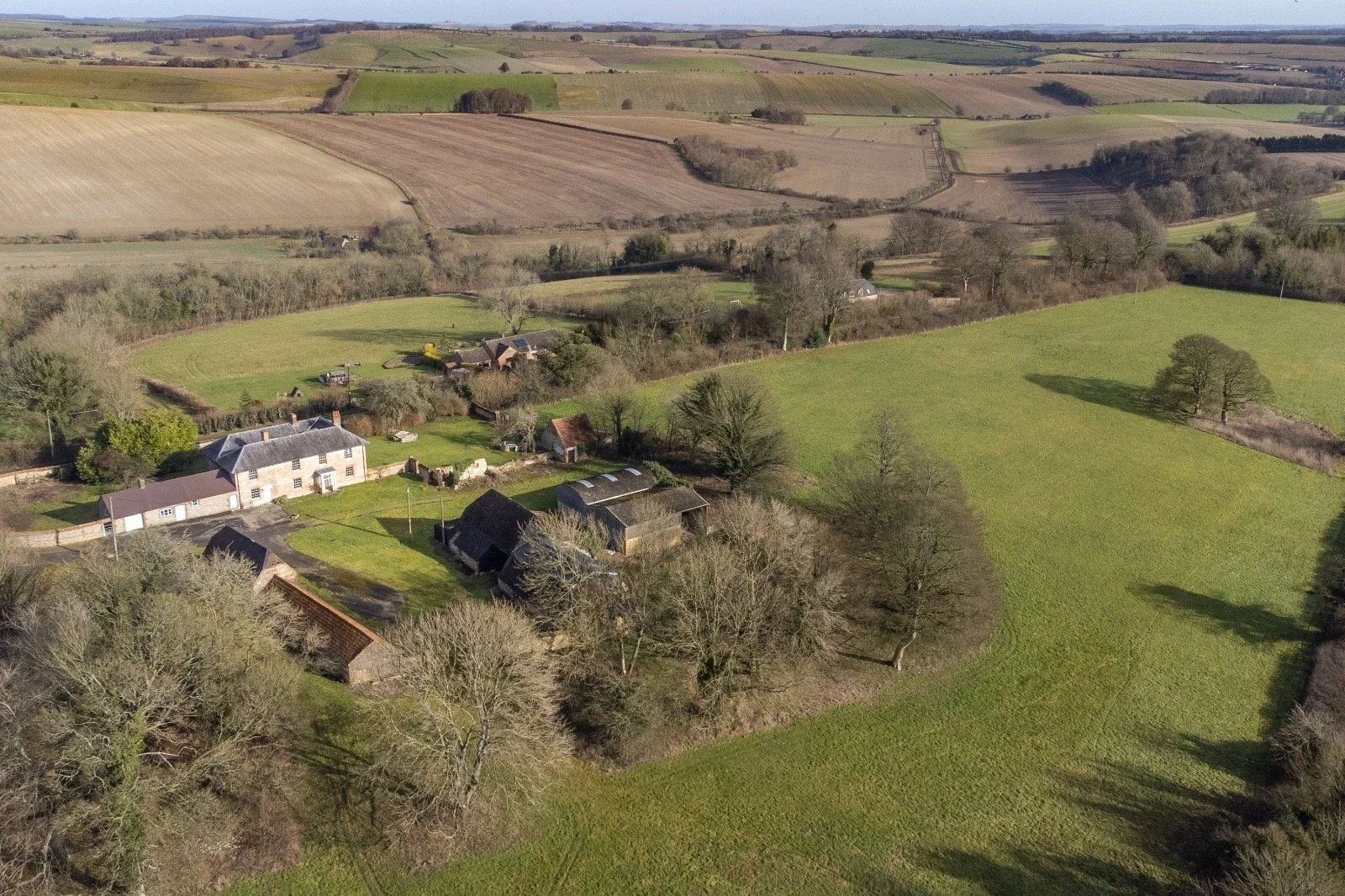
That is the particular pleasure of Dudmore Lodge. You are not simply staying in a historic house. You are inhabiting a place that has survived Tudor England, Civil War, agricultural transformation and centuries of changing lives, a house still carrying its past quietly into the future.